Wednesday, May 28, 2025

Vintage Shopping: The Future is Now


There are many reasons to shop Vintage aka Pre-loved aka Thrifted. It's always been right for:

> Those who love the thrill of the hunt

> Those who appreciate the styles/construction/fabrics of the past

> Those who love to snag a bargain or a "find"

> Those who pursue a unique style all their own

Shopping Vintage has other benefits as well, not the least of which are:

> To counter over population in your closet due to the rise of fast-fashion shopping and its highly disposable garments. Besides, too much choice can be paralyzing.

> To save the world from what to do with all that unwanted donated apparel

A sobering dead end

> To fight the rising cost of clothing, which, especially with the uncertainty of tariffs, is likely to continue     

> As part of the decision to buy nothing. It doesn't seem as wrong to give a new home to something as opposed to encouraging fast fashion to get even faster. 

> Realizing you really don't need anything but as an inveterate shopper do need to scratch that itch. It's both the thrill of the hunt AND unearthing the treasure.  

Jane Fonda, at age 83 was quoted as saying she wasn't going to buy any more clothing.  She said she was still wearing clothes she bought 30 years ago in multiples because her then-husband Ted Turner had many residences. She's 87 now; I wonder if she's kept that promise. 

Jane Fonda has all she needs

Vintage is a term that has loose definitions. An antique piece of furniture, for instance, needs to be 100 years old to be considered antique. "Vintage" denotes anything more than 20 but less than 100 years old. "Retro" fills the gap at less than 20 years. 

You can see for yourself how those don't necessarily apply to clothing. Retro can be a designer's term for bringing back the '70s while a consignment store will call the original piece Vintage. Wearable clothing never seems to be labeled Antique either. Great Grandma's Edwardian wedding dress, over 100 years old, is still Vintage.

To further confuse things, "Vintage" has become the acceptable term for anything pre-worn (or "pre-loved") as opposed to being called "used" or "second-hand". Goodwill and the Salvation Army don't bother with these distinctions, but shopping them is usually to look for something Vintage—better in quality than the usual. 

For the sake of convenience I'll just be calling all this stuff vintage.

* * * 

Personally I've only tip-toed into vintage shopping. Here in Houston there are dozens of re-sale shops where the Young & Restless can drop off or exchange their (mostly fast) fashions for cash or more of the same. My favorite among them did have a client just my size with a Marc Jacobs obsession, but she seems to have moved on (as has he). More and more these kinds of places are bringing in new, cheap stuff to add to the old cheap stuff. So buyer beware. There are a very few quality vintage shops, but they tend to feature old St.John knits and massively sequined, heavily shouldered party dresses. 

So I am going to defer to my very experienced friend, Diane O. She has the advantage of living in New York City. Not only are there women galore who love fashion, New Yorkers have notoriously small closets. Thus the constant trek to unload and repurchase. Through trial and error Diane has figured out what works for her and along the way has compiled a hefty roster of tips how to play—and win—at vintage shopping.
 
AllWays in Fashion: How did you get started vintage shopping?
Diane O: I noticed that more and more vintage and secondhand stores were opening near me, and I was curious! After a while (and a lot of bad choices), I started to learn how to identify a keeper. I haven't sprung for high-end, three-figure vintage, but you can stay under that and find some real treasures.
 
AWIF: What were some of your best buys?
DO: The Issey Miyake crinkled turtleneck in a beautiful clear blue, which is timeless. The '70s men's fitted shirt in a print I think of as "disco Christmas"—the ideal holiday party shirt. The Liberty print I had tailored to fit. And my favorite before/after: the patterned ski sweater with two buttons missing and a mismatched one hanging by a thread (I replaced the whole set with new metal buttons).
 
AWIF: And the worst?
D.O: Probably pants. They're hard to fit under any circumstances, and if you find them in a secondhand store, they may be dated-looking. Some, I've found out the hard way, are beyond alterations. If you have to basically re-cut a pant, it's not worth it.
 
AWIF: What are you always looking for?
D.O: An interesting top. 

AWIF: What will you never buy?
D.O: Shoes. A little too much personal contact for me!
 
AWIF: How do you style a vintage piece with what you already own?
D.O: Let the piece be the standout—if it's very distinctive, don't wear anything that competes with it. And if it's clearly an old style like my disco shirt, keep the rest of your outfit modern. Head-to-toes '70s looks like you're going to a theme party, and you never want to be that literal.
 
AWIF: What else would you like the world to know:
D.O: Not every trip will be productive; most aren't. But they do train your eye. Once you find stores you like and learn to be selective, you'll go home with more winners. 

D.O in "Disco Christmas"
 
A little caution goes a long way, and Diane O. has also identified some things to watch out for when shopping for vintage:
 
> Don't succumb to nostalgia for "when clothes were good".
 
> Don't be seduced by a label or beautiful fabric. That won't matter if it doesn't fit or you don't need it.
 
> Be wary of styles that don't really pair well with modern clothes. "We've moved on and you risk looking clueless".
 
> Run, don't walk away, from anything that reminds you of something you once loved. "Your body has changed, a lot of that stuff was too prissy; some things are actually better/easier in current versions, like pants with Lycra".
 
> Say no to a one-off that might be a gem but will go with nothing you own.  The idea is not to then have to go shopping for something to make it work!

> Be wary of the "feeling that you have to go home with something to reward yourself for the effort of searching." Instead, buy yourself a bouquet of flowers or stop in a lovely coffee shop for a treat or pick up that new best-seller.
 
> Don't let the price overtake you. "You can't go wrong? Yes, you can".
 
> If you have to justify the purchase with an explanation of its backstory or where you found it, think again. "Your outfit shouldn't need a caption".
 
> If you know it "probably won't work, but you're going to make it work, dammit", just calm down. "No tailor is that good".
 
> Since we all learn by our mistakes, you're going to make some and get wiser. But never let any mistake hang in the closet to taunt you.
 
* * * 
 
We both agree that "the more attractive the shop the more pleasant the experience". Neither one of us will shovel through massive piles, and we are both discouraged by finding too many lemons. The nicer things are displayed, the more one feels they are in a "real shop", and the more inclined we are to spend time there.
 
Su'juk (top) and City Opera Thrift, two NYC faves


Wednesday, May 14, 2025

Fine and Dandy

Janelle Monae disguised as a suit for the Met Gala

"Superfine: Tailoring Black Style" is the latest excuse for holding a Met Gala. If that seems a bit harsh I will admit to wondering if that affair is Fashion or Entertainment. The intent of the exhibit itself is to interpret "the concept of dandyism as both an aesthetic and a strategy that allowed for new social and political possibilities" in the Black community. Those are big words for a term that historically had a different definition. I'm thinking the "dandy" as referring to a male figure of fashion is different from the "dandy" the Met is showcasing.

So what is a dandy? From the late 18th into the 19th century a dandy was a man meticulously concerned, top to bottom, with his appearance and adherence to the latest fashions and styles. Being white, wealthy and male were prerequisites. This dandy didn't just "dress up" for the public; he wouldn't be caught, dead or otherwise, not looking splendiferous. Examples: Beau Brummel (the first dandy of note), Oscar Wilde, Lord Byron. 

Brummel, Byron, Wilde

In the 20th century the author Tom Wolfe took great pride in being a dandy. By then the look was anachronistic. Wolfe would choose items such as spats, a fedora or a cane that were long out of popular fashion. Wholehearted dandies like him are few.

Brummel, Byron, Wilde, Wolfe

The Met has woven together what looks like a gangbusters of a show of American Black fashion from the 19th century to today in a concept of twelve themes and featuring hundreds of garments, accessories, paintings, drawings and videos. This is the first Met Costume Institute show devoted entirely to men.

I love the example of this livery coat and waistcoat from 1840s. It was worn by an enslaved man on a Southern plantation and shows his owner's preoccupation with an ostentatious, dated form of displaying wealth. It pains me to think how humiliated the wearer must have felt. This would not have been his choice but his master's.

Dressing the part

In stark contrast are photographs of Frederic Douglas, the great orator, statesman and aboltionist. He knew how to get his point across. As one of the most photographed men of the 19th century he was aware how he looked and what he wore would be scrutinized. But did using the power of dress to influence make him a dandy? 

Frederick Douglass

The spirit of the late Andre Leon Talley permeates the galleries. Talley, close to Vogue editor Anna Wintour, was the magazine's fashion news director then creative director from 1983 to 1995. He was so much more—a figure of prominence from the disco days of the '70s until his death in 2022. He could surely be called a dandy in his youth. He developed the unique style of his later years as a solution for various weight and health problems. 

Talley, always unique

Although its official title is a mouthful and a bit vague, calling it about black dandies would be wrong. What and how you wear it signals loud and clear your hopes, dreams, aspirations and rebellions. Despite my dithering about definitions, the whole show sounds impressive, thought provoking and a must-see.

"Superfine: Tailoring Black Style" will be up at New York's Metropolitan Museum of Art through October 26.


Friday, April 25, 2025

Enter Mrs. Exeter

I've only just realized that "Mrs. Exeter", Vogue magazine's imaginary mature woman, was a play on  the title of Sergeant's painting, "Madame X". I've been reading about Mrs. Ex in "1950s in Vogue—The Jessica Daves Years" by Rebecca C. Tuite. 

Jessica Daves was the unsung editor of Vogue magazine from 1952-62, important years for American women and fashion in America. Mrs. Daves loved the name "Mrs. Exeter", and now I see why. Unlike Sargent's painting, notorious for its since-replaced slipped strap, Mrs. Exeter was the pinnacle of chic correctness.

"Madame X"

Mrs. Exeter was first introduced to Vogue readers in 1948. At the time Jessica Daves was "active editor". She would become editor-in-chief when Edna Woolman Chase retired in 1952. By that time Jessica was 58 and Edna 72. It makes sense they thought having a Mrs. Exeter was a smart move.

As I myself have certainly discovered, one doesn't stop loving fashion on a particular birthday. The target age Vogue chose for Mrs. Exeter was "approaching 60". In theory women that age have more time and money to spend on beauty and fashion—that may in fact have been true back then—and Jessica Daves was nothing if not conscious that Vogue was a business. The more readers it could connect with, the more advertisers would sign on. 

But I do feel Mrs. Exeter was a labor of love. Not only was she given the personality of the observant Mrs. Daves, she was enjoyed by all Vogue readers as the voice of that wiser, fashionable, big sister, aunt, parent, friend. 

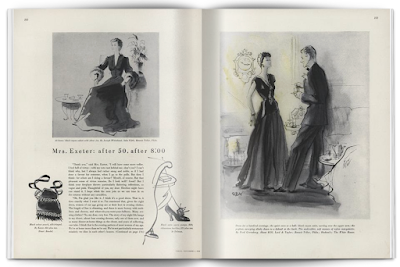
Mrs. Exeter also appeared twice on the cover of American Vogue (one above left). British Vogue had their own Mrs. Exeter (right cover) often "played" by one model specifically recruited to fit the role. The American Mrs. Exeter began as illustration then morphed to photography. No one model assumed the role.

The British Mrs. Exeter

Quite a few "Mrs. Exeter" features showed her wearing Vogue Patterns, and I think I know why. Many women's magazines were also tied into sewing pattern companies (McCall's would be an obvious example). Conde Nast owned quite a few besides the Vogue brand. Magazines were beholden to run at least a few pattern features a year. As a reader and creator of my own wardrobe I loved when they did. Once I joined the staff of a fashion magazine myself, I saw the required pattern features were treated respectfully but with no real enthusiasm.

Early illustrated Mrs. Exeter
Photography and wise words from Mrs. Exeter
For Mrs. Exeter (or her seamstress)

Besides showing off her good taste in clothes, Mrs. Exeter penned a column that shared her musings. She was such a successful invention there was debate among Vogue readers whether in fact she wasn't a real person.

NB There didn't seem to be anything wrong with this in magazine circles. For many years the "Jake: A Man's Opinion" in Glamour was written by several men, none of them named Jake. At least they were men.

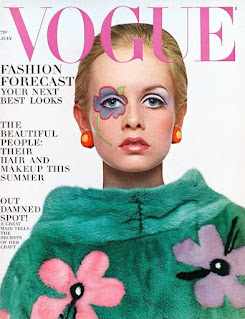
Looking, acting or being young were never goals of Mrs. Exeter's, who happily sported gray hair with her blessedly trim figure. When Diana Vreeland took over Vogue in 1962, Mrs. Exterer made her exit. No spring chicken herself (59 when she became editor in chief) Diana coined the term "youthquake" to describe what was happening in fashion and culture. We've been beholden to youth culture ever since. 

Vogue, July 1967


Monday, April 21, 2025

Forever the Ballerina


Degas loved to paint ballerinas. "The Red Shoes" unleashed a generation of wanna-bes. Audrey Hepburn found her heart's desire thwarted. Natalie Portman married the teacher.

Ballet has fascinated since its beginnings (around 1500 in Italy). The ballerina has become an ethereal, almost other-worldy creature, on display again in Amazon Prime's new miniseries, "Etoile", streaming April 24.


"Etoile" promises to be a potboiler of romance and workplace intrigue with beautiful locations, not to mention a gorgeous cast.

Once bitten little girls never get over the ballet bug. 

I saw "The Red Shoes" in 1948 (age 6) and begged my mother for ballet lessons for years. Never mind that "The Red Shoes" was a cautionary tale. I was far too young to understand the plot, but Moira Shearer was enchanting. Like all good performers she made it look easy. By the way, Moira Shearer was a dancer who had never acted when she took the role. 

Scenes from "The Red Shoes"

My mother wisely stalled on those ballet lessons as Gallumphing Gertie here would never have been successful. Undeterred I did take a few lessons at the Joffrey Ballet in NYC in the mid-'60s. They had open classes for $5 a session. Mr. Joffrey only took $10 from me. I realized it best to save my money for tickets to his wonderful productions. 

Scenes from "The Secret People"

Audrey Hepburn might be the world's most successful unsuccessful ballerina. She studied ballet throughout her childhood despite the privations and dangers of WWII. Audrey grew too tall (5'8") for a conventional ballerina but found work as a cabaret dancer. In one of her early films, "The Secret People", she was a ballerina in training. Eventually she danced on film with the great Fred Astaire in "Funny Face". Ballet's loss was truly our gain.

Portman and Millepied in "Black Swan"

Natalie Portman met Benjamin Millepied on the set of 2010's "Black Swan" where he was the choreographer and one of the film's dancers. She prepared almost a year for her part as another doomed dancer. Millepied is a classically trained pro who later became director of the Paris Opera Ballet. They were married in 2012 and divorced in 2024.

Dancers lead impossibly disciplined lives. Their workouts are brutal and never-ending, diets restricted and stringent, lives outside the studio or off the stage limited at best. They are almost always in pain and live in constant fear of injury. But that doesn't take away from our fascination.

Just think about the fashion classics that have come to us from ballet:

BALLET SLIPPERS
(from the real deal to street style)

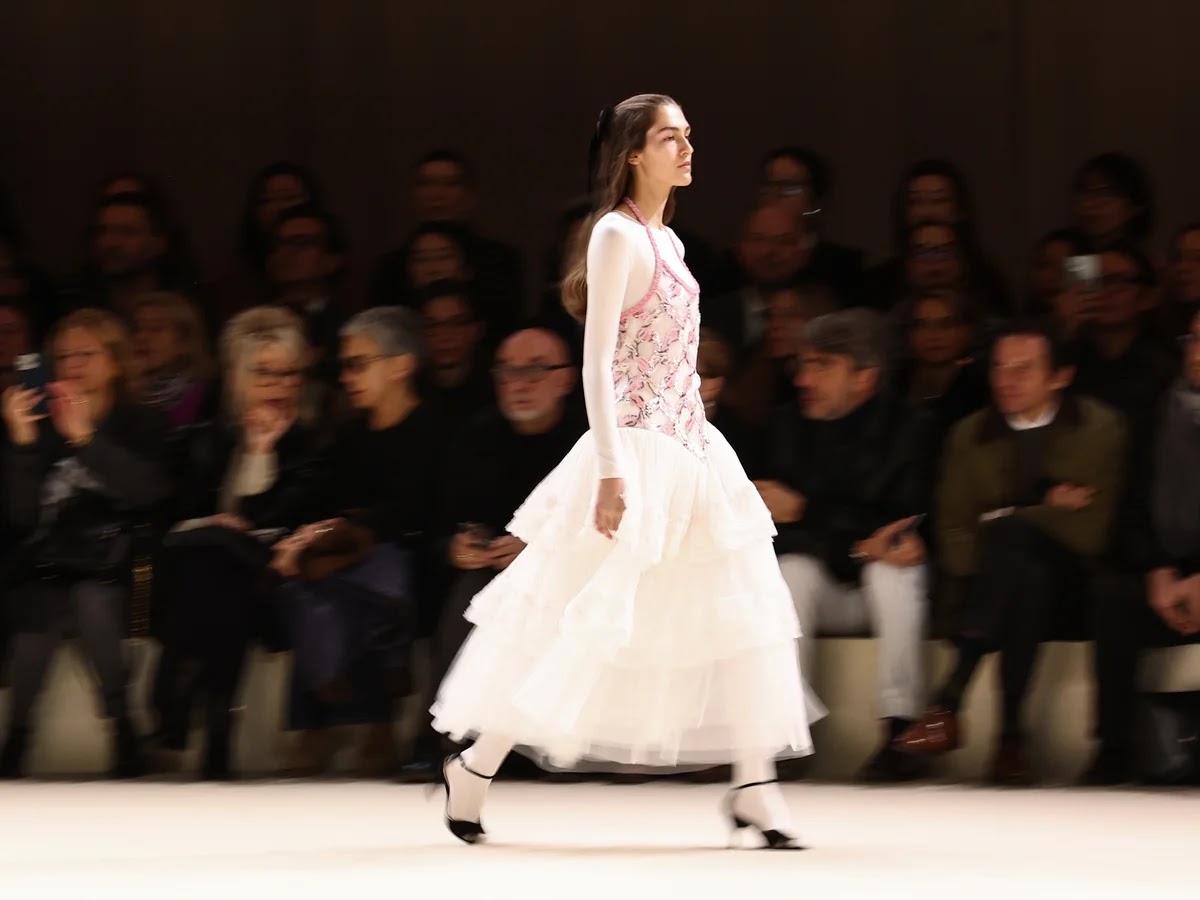
TULLE SKIRTS
(Giselle to Chanel)
LEOTARDS
(workout to going-out)
CHIGNONS
(OK so call it a bun)


Tuesday, March 18, 2025

Maybe Not Forever


Forever 21 has filed for bankruptcy. This filing, the second since 2019, will close all stores. Does this mean the end —or at least the beginning of the end—for "fast fashion"? I for one can hope.

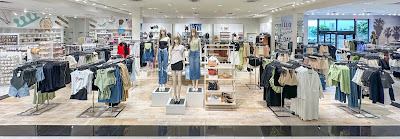
Selling cheaply produced and cheap to buy versions of trends aimed at the young and fickle, Forever 21 was founded in 1984 in Los Angeles by Korean immigrants, Do Wan Chang and Jin Sook Chang. They grew to 540 stores, mostly in malls, as well as having an online site.  By 2010 Forever 21 was so powerful it opened a two-story stand-alone branch outside a suburban Houston mall.

Waiting to open at Baybrook mall, 2010

At first I assumed Forever 21 was aimed at older women hoping to hold onto their youthful pizazz. I wasn't that far off as the founders believed "old people want to be 21 and young people want to be 21 forever". Even being 21 must seem old to teeny boppers, who inhabit their own fashion universe.  

Slightly off-putting were the words “John 3:16,” printed on Forever 21's shopping bags, that fueled suspicion the company was part of a Chinese cult. The mention was explained as a reference to a Bible verse that "shows how much God loves us".

Forever 21 encouraged a cringe-worthy, body-baring, over-sharing style of clothing that (my opinion here) eventually trickled down into mainstream fashion. It sold everything from apparel to shoes to accessories for both men and women, aka boys and girls.

As far as the eye can see...

Forever 21 followed in the footsteps of Abercrombie and Pac-Sun in its appeal to the young and gave new life to old mall brands like Charlotte Russe. I think its popularity encouraged Target to up its game and compete in this lucrative market. Coincidentally Forever 21 never had the cache of Zara or TopShop. They fought some contentious legal battles with established designers such as Anna Sui and Diane Von Furtstenberg over copying. The outcome was inconclusive as clothing designs can't be copyrighted.

Did I ever shop there? As an equal opportunity shopper, in the beginning, yes. And I did find one or two things I actually wore—a raincoat, I think, and some chunky costume jewelry that wasn't trying to be anything but. As time went on fashion changes/they changed/I changed...who knows? Unlike many, many other places that have closed (the flagship Neiman Marcus in downtown Dallas!), I won't mind that Forever 21 didn't last, well, forever.

This was never me...


Saturday, March 8, 2025

Ah, the New Yorker!

Issue #1

The New Yorker, the magazine, is celebrating its first hundred years in 2025. Few publications I enjoyed when I was young are still around; this one taught me how to be a grown-up.

I was twelve and had a regular Saturday night gig babysitting for a family who had moved to Cleveland from the east coast. They brought with them a subscription to The New Yorker, delivered weekly then as now. After the kids were safely stowed away in bed I plunked myself down in the living room, which I can still picture in all its faux-1955-Colonial glory: an upholstered wing chair facing the fireplace with a reading lamp and magazine rack by its side. 

Every week there appeared on that rack a new copy of The New Yorker, and every week I went through it page by page. Did I read any articles? No. I did look at every cartoon and enjoyed the completely unrelated illustrations that decorated pages of text.

What caught my attention week after week were the ads. The companies never changed. Maybe Brooks Brothers had a different jacket or that week were advertising shirts, but there was always a Brooks Brothers ad, and it always looked the same. There were many, many tiny ads—for basket bags from Nantucket, pure Scottish cashmere argyle socks, hickory walking sticks from Maine, etc.—a plethora of goods that were never advertised or seemingly needed in Ohio. The focus of goods seemed necessary for the lifestyle of New Yorkers. I assumed they took a lot of vacations.

I soon realized that New York City was THE place to be. In another year I would have decided to move there myself as soon as possible, although college in NYC was a dream that never materialized. I had no idea what I was going to do in Manhattan, but I assumed when I arrived I would need my family tartan kilt, or at least a gold safety pin, and a handmade fishing creel, and Belgian shoes (whatever they were) and anything else that was continuously advertised in the New Yorker. 

In reality, when I really did become a New Yorker, I rarely bought the magazine. If I looked at a copy in a waiting room it was still for the cartoons or to read one of their pithy short movie reviews. The New York Times had become my source for all things New York (and still is). 

Exhibit at the New York Public Library

There was more, much more to it than the magazine itself. The New Yorker has a mystique and a history that has filled many books. What seems like a terrific exhibit at the New York Public Library celebrates The New Yorker in all its aspects. Wish I could click my feet together and take it in, and I might do that. It will be up until February 2026.

Just for fun I got a copy of the current issue. The cover price: $9.99, 78 pages, almost all solid text. No little postage stamp-sized ads. Hardly any ads at all. One for a hotel or apartment in Dubai (didn't say which), a couple ads for New Yorker related items, two institutional ads (NAACP and a benefit for God's Love We Deliver). The only other ads: Loro Piana, the Wall Street Journal Wine Club and Skechers. The New Yorker is still teaching us how to be New Yorkers after all.

Friday, February 21, 2025

Au Revoir, Joann's

Not my sewing studio though I wish...

The news that Joann's, the fabric and crafting supplies emporium, will be closing 500 of its 800 stores in the wake of its second bankruptcy, is a blow to all quilters, knitters and home sewers out there. Joann's has been a reliable source for the tools and inspiration of its many devotees. They were not, obviously, enough to keep Joann's afloat. 

I haven't sewn a dress pattern in ages. I stopped making pillows when an insert alone equaled the price of a beautifully finished pillow at TJ Maxx. I've been knitting the same sweater for three years. The yarn alone cost more than a winter coat. 

The imminent loss of Joann's brings to mind the lovely memories of home sewing, something I've written about before:
https://allwaysinfashion.blogspot.com/2021/11/the-worst-grade-i-ever-got.html

Nearly departed

Interestingly Joann's was founded the year after I was born in the city where I was born and grew up—1943, in Cleveland, Ohio. I don't remember it as a place to shop for fabrics and patterns. Back then every downtown department store had a section where they sold fabrics, patterns, notions and of course the latest machines.

We shopped at Halle's department store. Fabrics, like everything else from Halle's, had a stamp of approval from just being there. It may have been the same shipment of Bates cotton flannel that was at Higbee's or Taylor's, but Halle's gave it that extra cachet. I remember agonizing over which flannel to choose for my first official sewing project in ninth grade (pajamas) and chose a Tyrolean print with a blue background because it looked like Lanz*.

Also in that distant past, pattern manufacturers would print small sized newsprint mini mags to preview the newest patterns. I'd always stop by any fabric department to pick one up. But, oh, how I really wanted one of those 10-pound, oversized beauties that showed all the patterns. Alas, I could never convince a salesperson to let me take one away.

Preferably Vogue, but I'd take any

Buying fabrics online is near to impossible. Never mind color accuracy, fabric is something you have to touch. No small reason the feel of a fabric is called "the hand". And where else to replicate the joy of getting a new box of crayons than choosing the thread you will spend the next 400 hours with or the yarn that will magically, under the touch of your nimble fingers, turn into a cardigan in the next five years. I'm giving myself two more years to finish.

The loss of Joann's is just another blow to the disappearing art of leisure activities. We too often fritter away our time scrolling through Instagram rather than making bound buttonholes or mastering the feather stitch. One is not as satisfying as the other two. 

Like calligraphy and vinyl, maybe sewing, knitting, crocheting, quilting and everything else one needs to go out and buy stuff for, will return. And so will Joann's.


* Lanz was a manufacturer of desirable Tyrolean-inspired cotton dresses very popular with readers of Seventeen and Mademoiselle (like me). 

Update February 25, 2025: No au revoir to Joann's, I'm afraid. It was just announced all 800 stores will be closing. So this is goodbye.

Saturday, February 15, 2025

Stylish Streaming: "Cristobel Balenciaga"

 
I wish I could highly recommend "Cristobel Balenciaga", a 6-part series streaming on Hulu. There is much to admire in the Spanish production. The settings and Balenciaga's fashions are lush, the actors invested in their roles. But when you begin to care more about the peripheral characters—Chanel, Dior, Carmel Snow, Givenchy—something is wrong.

Alberto San Juan as the enigmatic Balenciaga

That something is Balenciaga himself. There is a difference between shy and anti-social. Dior has been described as shy, although he is presented here as quite gregarious. Balenciaga is anti-social. He peers behind a curtain during his presentations and hates to mingle. He eschews all interviews. He controls who can see his shows and releases his own photographs to the fashion press. He seems so uptight one can imagine him sleeping in a suit and tie. Does he get away with it because the clothing is so gorgeous? 

A young Cristobal

It would be helpful to know something of Balenciaga's background before viewing. Born in 1895, he was a successful couturier in Spain before leaving for Paris in 1937 in the wake of the Spanish Civil War. His clothes were beautiful and the most expensive in town but not particularly innovative.

He declared himself anti-political during WWII and managed to do well during the Nazi occupation. Post WWII Dior's "New Look" changed the direction of fashion. Balenciaga followed his own instincts, creating over time the tunic dress, the chemise, the cocoon coat, the balloon skirt, the baby doll dress, the Empire line and kimono coats, all widely copied by the other couturiers. He was always known as the "designer's designer" and admired and respected despite lone wolf status.

Only a smattering...

Balenciaga resisted adapting to a changing business model, instead closing the House in 1968 and retiring to Spain. He died in 1972 at age 77. The "Balenciaga" of today is his in name only, a move he would have despised.

The series itself moves slowly. Almost one entire episode is devoted to designing the wedding gown for Fabiola, a Spanish noblewoman who married the King of Belgium in 1960. That her body was meticulously measured and its flaws hidden in construction was fascinating, if perhaps a little in the weeds for a casual viewer.

Queen Fabiola

Indeed some of the the most delicious moments for me were watching scissors slice through fabric whenever something was being cut. I only wish mine were half as sharp.

Cristobel was stubborn as the day was long, grumpy and downright insulting to the devoted Ramon, his long-suffering companion. He never seemed happy in his own skin and was respected but feared by those loyal to him. Alberto San Juan's portrayal allows us to imagine a softer person beneath Cristobel's stern demeanor. There would be a flicker of a smile, quickly suppressed. Only Givenchy, as a platonic friend, brings out his softer side.

I think Givenchy's story would be the sunnier, happier one. Anybody listening?

"Balenciaga" is a bit like "Phantom Thread", the film starring Daniel Day Lewis as a prickly fashion designer, but without the mushrooms. Balenciaga's designs were beautiful, unique and innovative. Admired by his peers, they referred to him as "the master". But he was a hard man to love.

Cristobel in his element