Thursday, October 25, 2018

Stylish Cinema: "Two for the Road"

 
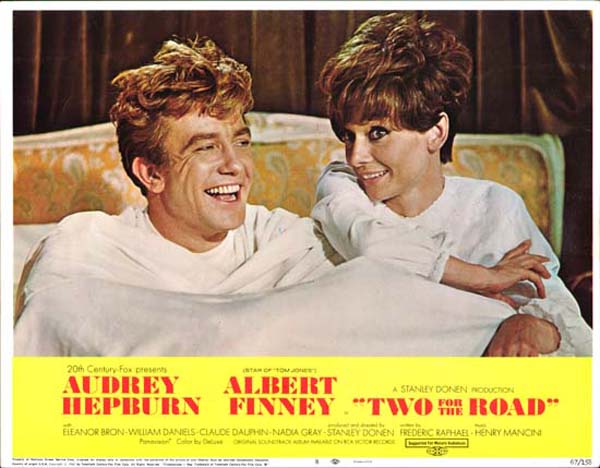
I recently watched this 1967 film for the first time in many years. I was amazed how my perception had changed over time. "Two for the Road" was originally billed as a romantic comedy, but it takes a thought-provoking look at relationships and marriage. What I once saw as a vehicle for Audrey Hepburn in some great clothes, I now realize was a tragi-comedy with a questionably happy ending.

This time, too, I realized the power of those clothes. Someday the art of the cinema wardrobe will be better recognized for the role it plays in movies. Not just the gaudy and/or delicious costumes, the ordinary "stuff" that defines a character.

As in life when we adopt different styles, to blend in or define who we are, Audrey's character is identified by what she's wearing. Director Stanley Donen had to make that clear as he chose to trace 12 years in the relationship of Joanna (Audrey) and Mark (Albert Finney) in scenes that flash in and out over time.


As student Joanna in the mid '50s, Audrey wears blue jeans and a pullover sweater. These are the clothes of someone happy to blend with her contemporaries, but they are timeless choices as well. I wonder if Donen was trying to say something about the timelessness of first attraction?

Newly married, her clothes are a bit more grown up. There's a trench coat in one scene. I remember thinking that was a "must-have" when I was a young working woman. She becomes a mother, and it's practical tops and bottoms. The present-day (1967) Joanna, wife of now-successful architect Mark, wears the latest fashions (and looks fabulous). This was a "new", sophisticated Audrey. I remember coverage in the fashion press of her cropped hair and outfits from the film.

Suit by Michele Rosier, Vogue, 1967

By this time Audrey Hepburn was associated with Givenchy as her designer of choice in films and private life. In "Two for the Road", however, Audrey wore "off the rack" clothing, including some fancy racks like contemporary stars Paco Rabbane, Andre Courrèges, Mary Quant, Michèle Rosier, Foale and Tuffin, and Ken Scott.
The fabulous Paco Rabane outfit
 
Hair plays an important role as well. Because of the flashbacks it was important to easily determine the year of the relationship, and the hairstyles do that fairly well. Joanna as student has simple Alice in Wonderland hair. Newly married, she has bangs. A few years on she has her hair short and fluffy. As a mother, it's simple and long again. The 1967 Joanna has short hair precisely cut in the Sassoon style of the day.

Student and newly married...
Young married and mother...
Sleek sophisticate

Something else colored this viewing of "Two for the Road". Audrey's marriage to Mel Ferrer was breaking up; they divorced shortly after filming. I have it from a very good source that Audrey and co-star Albert Finney had both great on-screen and off-screen chemistry. It was in fact a serious affair; in the end Albert Finney broke her heart. Audrey needed time to recover, and my source provided her with a safe haven. I can't say anything more unless the lady herself wishes to, which I doubt. Knowing that, the "chemistry" is like watching fireworks, bittersweet on account of Audrey's eventual heartbreak.


When I initially saw "Two for the Road", I had not yet found my own Mr. Right. I only saw the surface gloss—from the bloom of young love to that (possibly) happy ending. Today I know it's not easy for relationships to survive, but they can and do.


Amazingly the fashion in "Two for the Road" still looks good and wearable after 50 years. That may have been Audrey Magic and why she remains a style icon to this day.


Monday, October 22, 2018

What's Wrong with Fashion Today

 
If a picture is worth 1,000 words, I've written my piece. Above is one half of a real two-page Gucci ad in the October Harper's Bazaar. This is frightening and depressing. 

Fashion does not have to be practical. It doesn't have to be pretty. It can be provocative, thought-provoking, curious, understated, over-stated, minimal, maximal, or even boring. It should engage both the viewer and the wearer. While it's easy to be caught up in the trend of the moment, time and a wise eye let you know what's right for you.

All this is rather cerebral. Our first fashion reaction is usually either "I like it" or "Not for me". Forget about whether we would really spend $1350 for a rainbow-striped puffer vest, cute as it may be.

Burberry, $1350
 
What fashion shouldn't elicit from you is "Oh my God! What is this?" or a plaintive "Whhhhhhy?" I can't justify the deliberately ugly. The whole idea of making oneself look laughable or grotesque on purpose escapes me. It's just a bad sign of how far off the track we've gone and a terrible reflection of everything that's wrong in the world—you name it.

If Alessandro Michele at Gucci doesn't really expect us to don a sock money ski mask, Faster Pussycat Kill Kill sweatshirt or hang a bus conductor's coin purse around our necks (all three together mind you), why show it, and on a 15-year-old on a bare mattress in the attic? If he's trying to make a statement about the state of the world I got that already. Please, not Fashion too.


Friday, October 19, 2018

Stylish Read: "Fashion Climbing"


"We all dress for Bill."
 
Bill Cunningham was New York's most popular party guest. He never ate or drank and didn't stay long. He mingled with guests but said very little and had more invitations for an evening than he could ever attend.

Bill Cunningham divided his time between photographing the stylish of New York society and the stylish on New York City's streets. It was his third, fourth or fifth career.

His posthumously published memoir, "Fashion Climbing" is about those early careers—stock boy for Boston department stores, army tour guide extraordinaire, hatter and all-around madcap, then fashion reporter for Woman's Wear Daily and others. The photography gig that made him famous is barely mentioned.


Reluctant to talk about himself, he participated in the wonderful documentary "Bill Cunningham New York", but revealed little. It was quite a surprise when relatives discovered this unpublished memoir. Even more surprising is how warm, funny and chatty a read it is.

Young Bill the Hatter

It's not clear when "Fashion Climbing" was written. It seems to end mid-60s when Bill was still reporting on fashion but no longer for Woman's Wear Daily. St. Laurent has taken over at Dior but Balenciaga is still alive and designing.
 
The term "fashion climbing" is one I had never heard; he uses it to represent social climbing with clothes. I might take exception as he states that this began after World War II, when women no longer "wore lovely clothes for the sheer pleasure and joy of pleasing their friends." I would think status dressing has always been a thing, from the days of the House of Worth to having a "store bought" as opposed to a "home made" dress.

For one who first became aware of fashion when women really did still wear hats, his stories of New York City, late '40s through '50s, showed me how much I missed. No other American city was so tuned to the power of fashion. What a show it was, and Bill Cunnigham relished watching every minute of it.

Editta modeling a hat for Bill

He doesn't always name names, but it's easy to figure out a few of the unnamed. I immediately recognized Editta Sherman, his long-time friend and neighbor at the Carnegie Hall Studios. A photographer herself (that's her on page 231), she would rent her studio to visiting foreign photographers. By the mid-'60s I would often be sent to pick up processed film as part of my duties at Glamour Magazine. Unfortunately I never saw Bill there.

"Fashion Climbing" could have used a good editor in places, but then it wouldn't have been like having a conversation (over tea and a sandwich at Schrafft's) with such a wise and slightly wicked charmer.


Thursday, October 11, 2018

Jane Arden, Fashionable Girl Reporter

  
I wish I'd known Jane Arden; looks like I really missed something. Jane was a "spunky girl reporter" who romped through the comics from the '20s through the '60s.

1920s

1930s
1940s
1950s
 
Jane differed from her girl reporter comics rival Brenda Starr in that readers were able to send Jane designs for her (very extensive) reporter's wardrobe. No simple, sensible suit and white blouse a la Lois Lane for her. Jane's wardrobe is a fanciful yet insightful look at what women wore (or dreamed about wearing) for over 40 years.

Phyllis Coates as Lois Lane

First syndicated in 1928, Jane Arden appeared in newspapers and comic books, movies and paper dolls. She never achieved Starr status in the United States but was quite popular in Canada and Australia.

The Beyonce of the comics

Katy Keene was a comic queen with reader-inspired dresses, but she was too much of hot tamale for my taste. I would have sent in contributions for Jane, earnest girl-with-a-job and on a mission, many missions.


The reader contributions never took up much space on the comic pages (about 5" x 6"), but they must have been lovingly saved by generations of readers. Many page clippings are listed for sale on ebay. There is also a reproduction 1942 paper doll book. I'm eyeing that. Never too late for fun with paper dolls.


Friday, October 5, 2018

Dress Like Florence...for $9.99


I'm still on a high after seeing Florence and the Machine in concert last Sunday. I've written about Florence before. You can find it here:
http://allwaysinfashion.blogspot.com/2016/05/women-we-love-florence-welch.html

 
Florence has been a muse of Gucci for several years, and the brand's Bohemian style suits her. That night she performed in a dreamy chiffon Gucci dress. Florence twirled and danced on and off the stage (barefoot); it was no surprise to see raw skin on her knee and smudges of blood on the dress. Not missing a beat, she said, "You know it's a good night when you get blood on a Gucci dress!"

  
The latest H&M collaboration was unveiled today.  No, it's not with Gucci, but this textured chiffon blouse reminded me of Florence. Amazingly it's only $9.99!

H&M has partnered with Morris & Company. The British wallpaper and fabrics brand was started by William Morris and some fellow pre-Raphaelites in 1861. The style was known as Arts and Crafts; Morris' intricate nature-inspired patterns surely influenced Art Nouveau.

Although the firm officially closed in 1940, the designs are still popular. Liberty of London, custodian of the archive, worked with H&M to create the collection. I would suggest you get to your nearest H&M fast, because it won't last. Everything is wearable; the quality is decent, the prices are fair, and there is that incredible $9.99 blouse.


I really think Florence would wear this, maybe on a non-Gucci day. Certainly you could too.

Sunday, September 30, 2018

Madame Predicts: Turn Up the Volume

Balmain

Though I've quipped and quibbled in posts past about the crazy notion of multiple layers and football player shoulders, it's fair to say I think this is where we are heading—volume. It's also camouflage and protective layers. I have not a doubt in the world that this is in response to a primal need to dig deep and burrow, the polar opposite of reveal and flaunt. Could a thing like fashion possibly be influenced by politics and world order? Oh please, this is the real reason I loved history. Early on I saw the connection.

See
http://allwaysinfashion.blogspot.com/2016/08/years-of-fashion-part-one.html
http://allwaysinfashion.blogspot.com/2016/09/years-of-fashion-part-two.html
http://allwaysinfashion.blogspot.com/2016/10/80-years-of-fashion-part-three.html
http://allwaysinfashion.blogspot.com/2016/10/years-of-fashion-part-four.html
 
Too bad I couldn't form the same bond with math.

We expect New York Fashion Week to give us an idea what we may be wearing as we expect what's shown (or reasonable versions thereof) to be in the stores. We give London Fashion Week a bit more leeway, as I think there is a lingering question where it falls. The Brits were never known as Fashionistas, but then everything went global. Paris would be disappointing if it didn't seem far out. This time (Spring 2019) the Paris shows have struck a nerve and their outrageous does not seem that impossible. Be prepared.

Loewe
Celine
Dies Van Noten
Balmain

It wasn't all volume, but there were still signs of belted repression and hidden identities:

Ann Demeulemeester

Nevertheless I see plenty to love without giving up on society entirely. This dress is dreamy, though I would ditch the belt-worn-as-necklace and go for some sandals instead of boots. I already have a straw bag.

Loewe

Monday, September 17, 2018

Bye Bye Bendel's

 
Many notable New York stores have toppled since I moved to New York in 1964. Though I left the city in 2003 I will still be a New Yorker, wherever I go. Besides, I'm married to a boy from Brooklyn.

Best & Co. was already gone in '64, as was Russek's, an upscale specialty store most remembered today for being owned by photographer Diane Arbus' parents. Over time Stern's closed, then Ohrbach's, Bonwit Teller (of all places), Gimbel's (Gimbel's!!), then B Altman (unthinkable). A few years respite and even discount paradise Daffy's was no longer.

I still take each store closing personally and have had to mourn two big ones in the past year. In June Lord & Taylor announced it was closing 10 of its remaining 50 stores. Among them is the iconic flagship store on Fifth Avenue. I wrote about that here:
http://allwaysinfashion.blogspot.com/2018/06/goodbye-lord-taylor.html

Now comes news of Henri Bendel closing all its stores, which is sad but almost a relief. For the past six years Bendel's has given its name to a collection of accessories stores that bears little resemblance to Henri Bendel on Fifth Avenue or the mecca that was Bendel's on 57th Street. I've written about that here:
http://allwaysinfashion.blogspot.com/2012/06/tale-of-two-bs.html

I can't let Bendel's go to the happy hunting ground without relaying one last story. I've been incredibly lucky in my career, most notably because I didn't get the jobs I was totally unqualified for. That was not the case with my very first job. You might think I would have learned a lesson, as I suffered there for many months before moving on to something I was better prepared for. Alas, I would still fall for what sounded exciting.
Geraldine under the Bendel's awning

Such was the case when a former editor at Glamour, a friend of Bendel's president Geraldine Stutz, suggested me for the position of Bendel's art director. Why I thought I could be the art director of one of the chicest retail outposts in Manhattan is anyone's guess. I had no retail experience, no training in visuals and still a rudimentary knowledge of publishing. I loved all those things, mind you, but I didn't yet know how to do them.

I was in my early 30s and somehow just thought I could do it—until I walked into her office. I don't remember being nervous before the interview. I should have been. I would have been today, for goodness sake. Geraldine had a large, bright office and sat across from me at a very large desk. I suddenly felt quite small. I showed her my portfolio of layouts and drawings. She asked a lot of questions and told me what the job entailed. I wanted to run screaming from the room shouting, "I'm not worthy! No, really, I'm not worthy." I didn't because it dawned on me that this very bright, very smart woman could see I wasn't qualified and was a class act. She was incredibly gracious and never let on that she knew what I knew.

I think I loved Bendel's even more after that.

The "Street of Shops" in the 57th Street store

Thursday, September 13, 2018

What I Won't be Wearing #1: The Prairie Dress

 
What do they say about a bad penny? It always comes back. As if the 70s and 80s weren't bad enough, we now have the return (revenge???) of the prairie dress. According to the NY Times, it's b-a-a-a-c-k,  with a vengeance.


I can see how this happened. Spangles and shoulder pads are hard to pull off, just adding to the circus-like atmosphere many of us feel we are in. Westward ho? Now that was a time when we were were all blissfully ignorant and physically overworked.

"Little House" love...

This season's prairie looks hark back to "Little House on the Prairie" as filtered through the tv show's popularity and late '60s hippies. They are, however, costumes, and I'm not buying it.

I'm already in costume, as a 76-year-old-woman trying to look chic, attractive and relevant while wearing flattering clothes that reflect my personality. They also say you should never wear a look from an era that you've worn before. I summered in the Summer of Love and had my fair share of prairie skirts, Victorian nightdress blouses and (non-combat) boots. Worn traversing the streets of New York City, I might add.

Batsheva Hay in a field of flowers
 
Just so you know, this reincarnation did not sweep down from the actual prairie. The wizard of the look is Batsheva Hay, a New Yorker and former lawyer with two young children who has always loved vintage clothes. Married to an Orthodox Jew, she had already adopted a modest style of dressing. Two years ago she wanted to remake a vintage Laura Ashley dress. Since that required the expense of making a pattern, she decided to have several made in vintage dress and upholstery fabrics she found on ebay. Once others start copying you, and the Times writes it up, this is fashion worth noting if not wearing.

Laura Ashley 1986

Please don't let me keep you from your prairie dress. If you are young (in my book that's under 50), go ahead and do it. Turn off your cellphone. Bake some bread. Smell the roses. Just don't call this one Fashion That Must Be Obeyed.